If you’re living with spondylosis, whether cervical, lumbar, or lumbosacral, targeted physical therapy can offer real relief. This guide from the Brain and Spine Neurosurgical Institute outlines safe and effective spondylosis exercises to help manage pain, improve mobility, and support spine health. We cover both cervical spondylosis exercises and lumbar spondylosis exercises, including specific movements for lumbosacral spondylosis, and discuss exercises for spondylosis of the spine more broadly. You’ll also learn which spondylosis exercises to avoid, how to approach spondylosis therapy, and tips for lumbar spondylosis management. Whether you’re looking for exercises for cervical spondylosis, exercises for lumbar spondylosis, or a general guide to managing spinal degeneration, this resource offers professional, practical advice tailored to your condition.
What Is Cervical and Lumbar Spondylosis?
Spondylosis, also known as spinal osteoarthritis, is a degenerative condition that affects the spine. It primarily involves the deterioration of the intervertebral discs, which are the cushion-like structures between the vertebrae, and the facet joints, which are the small joints that connect the vertebrae in the spine. Spondylosis is commonly associated with the aging process, as the wear and tear that occur over time can lead to the breakdown of these structures.
Spondylosis is a common condition, especially among older adults. It can be diagnosed through physical examination, imaging studies like X-rays or MRI scans, and assessment of symptoms. While spondylosis itself is not reversible, its symptoms can often be managed through various approaches:
- Physical Therapy: Exercises that focus on improving flexibility, strength, and posture can help alleviate symptoms and improve function. Keep reading for some physical therapy exercises.
- Pain Management: Over-the-counter or prescription pain relievers can help manage discomfort associated with spondylosis.
- Lifestyle Modifications: Maintaining a healthy weight, practicing good posture, and avoiding activities that exacerbate symptoms can all contribute to managing spondylosis.
- Injections: Corticosteroid injections or nerve blocks might be used to target specific areas of pain and inflammation.
- Surgery: In cases where conservative treatments do not provide relief and symptoms are severe, surgery might be considered.
Cervical Spondylosis Exercises & Physical Therapy
Here are a few simple exercises that might help you with cervical spondylosis. Please note that everyone’s medical history is different, so you may feel pain that others do not. If an exercise causes pain, stop, and contact us at any time with questions.
Cervical Retraction
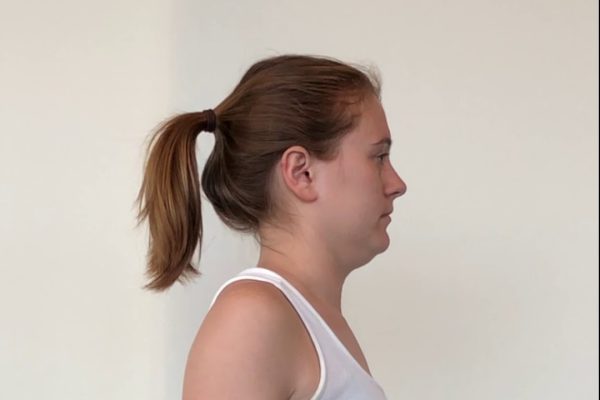
Our first exercise is cervical retractions. The goal of this exercise is to lengthen the muscles in the back of your neck. During this exercise, ensure that you are standing up straight with your shoulders back.
- Rotate your shoulders outward with your palms facing down and fingers pointing backwards.
- Retract your neck back while you inhale.
- Hold this position for about five seconds
- Return to a neutral resting position while you exhale.
- It is very important to keep your chin level during this exercise. You can do this by keeping your eyes fixed on a spot in front of you. Do not roll your head upward or downward while doing this exercise.
- Do this exercise three to five times.
Cervical Rotations
Our second exercise is cervical rotations.
- Rotate your shoulders outward with your palms facing down and fingers pointing backwards.
- Slowly and gently turn your head to the right and left, holding each end position for two seconds.
- Inhale as you turn your head to either side and exhale as you return to neutral.
- Repeat this exercise about five times in each direction.
Scalene Stretch
Our third stretch focuses on the scalene muscles. The scalenes are a group of muscles on either side of your neck.
- Position your shoulder on the same side as the muscles in your neck. This shoulder should be depressed. We can accomplish this in one of two ways.
- Hold on to the edge of a table or chair
- OR hold the shoulder down with your opposite hand
- Once your shoulder is in position, tilt your head slightly away from the lowered shoulder.
- Tilt your head upward as if you are looking at the sky.
- You should stop when you begin to feel a stretch in the side of your neck opposite to the direction your head is tilted in
- Hold this position for about 20 to 30 seconds
Levator Stretch
Last is the levator stretch. The levator scapulae muscle connects the upper border of your shoulder blade to the side of your neck.
- Rest your arm overhead against a wall corner or door frame. Do not push against the wall, just relax and rest your arm while standing up straight.
- Turn your head away from the arm that is elevated and tilt your head forward slightly.
- Stop when you begin to feel a stretch on the side of your neck closest to the arm that is elevated.
- Hold this position for 20 to 30 seconds
Lumbar Spondylosis Exercises & Physical Therapy
Here are a few simple exercises that might help you with lumbar spondylosis. Please note that everyone’s medical history is different, so you may feel pain that others do not. If an exercise causes pain, stop, and contact us at any time with questions. We are going to discuss four exercises that may be helpful to you if you’ve been diagnosed with lumbar spondylosis.
Flexion-Extension Exercise
The first exercise is a flexion-extension exercise. It is best to do these exercises on the floor, on either a soft rug or an exercise mat. If you have difficulty getting up and down from the floor, you can do these exercises on a bed, preferably with a firm mattress.
- Begin by lying down with your knees bent and your arms at your side
- Concentrate on the position of your belly button throughout this exercise. Let your belly button sink into the bed or into the floor and feel your back contact the surface. Do not go beyond this flat position. You should not feel your bottom lift up at all and all the motion should occur in the lower spine.
- Hold this position for five seconds.
- Bring your belly button toward the ceiling until your lower back arches just a little bit.
- Stop and hold this position for another five seconds. Again, your bottom should not leave the floor or the bed.
- Breathe in when you arch upward and breathe out as you flatten your spine.
- Repeat this exercise 5 to 10 times
Piriformis Stretch
Our third stretch is the piriformis stretch. The piriformis is a muscle that extends from the base of your spine, called the sacrum, to the outside of your hip.
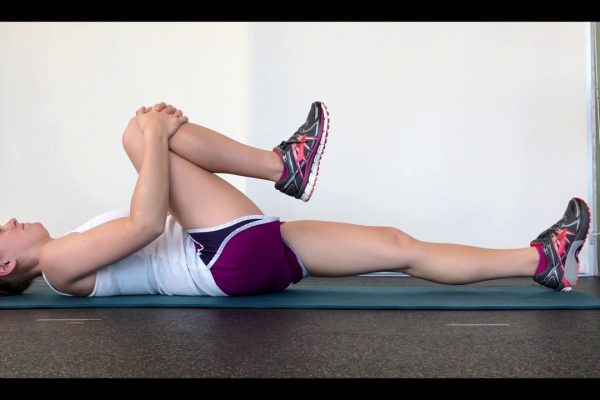
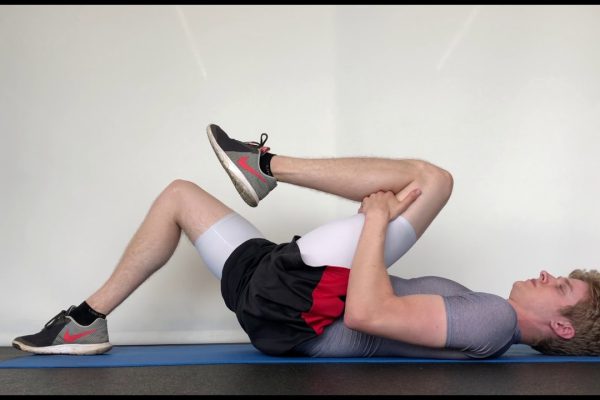
- Lie on your back with your knees bent and your arms at your side.
- Cross one leg over the other so that your ankle is resting on the lower thigh of the opposite leg.
- Place your hands just below the knee or behind the thigh of the stabilizing leg and slowly pull this leg back towards your shoulder.
- Stop when you feel a slight stretch in the buttock region or in the upper thigh
- Keep holding this stretch for 20 seconds
Step and Reach Exercise
The last exercise, Step and Reach, aims to improve your posture by promoting an upright position of the entire body.
- Begin with your feet together.
- Take a step forward on one leg while the other leg remains in place. After you have planted your foot, try to shift your weight to this leg.
- Reach upward toward the ceiling with the arm opposite your forward leg. In this position, the shoulder, hip, knee, and ankle on the side opposite your stepping foot should form a straight line down to the floor.
- Hold this position for several seconds and then step back to your original position.
- Repeat with the opposite leg and arm.
- Repeat 20 to 30 times, switching from one leg to the other as you go.